← All work

B&Q2012 — 2020Lead UI Specialist → UX & Development Lead

B&Q eCommerce Transformation

Years of continuous evolution — two major platform transformations that scaled B&Q’s digital channel from a small operation to a core revenue driver.

70xRevenue growth
£14MWeekly revenue
+34%Conversion
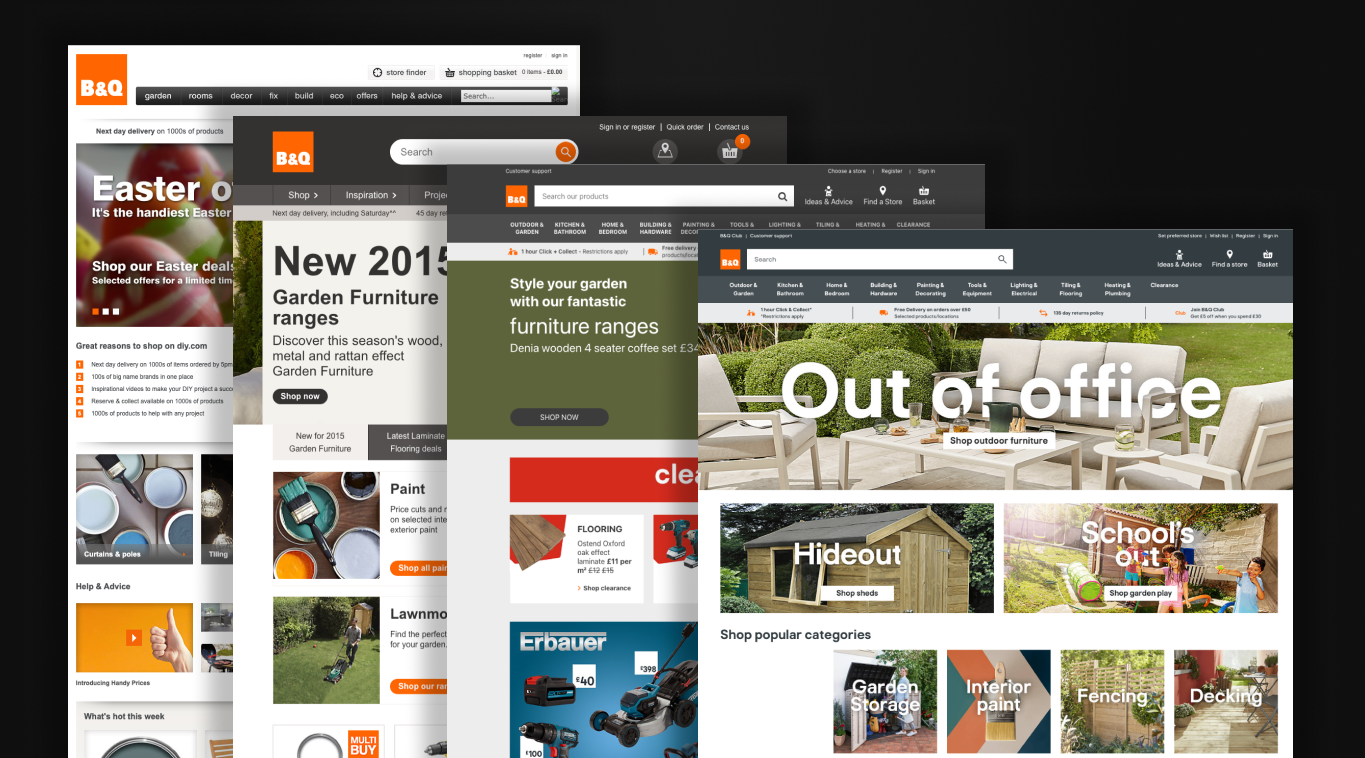
Four iterations of the diy.com website over the years
diy.com across two major transformations

The challenge

From small channel to core channel

Business problem

When I joined B&Q in 2012, the website was a small part of the business. Most sales came through stores, and the site was slower and harder to navigate than it needed to be:

  • £200k weekly revenue
  • A legacy platform with severe technical limitations
  • No mobile experience in a mobile-first market
  • 40,000+ SKUs, poorly organised

User problem

DIY customers are often mid-project, researching problems they don’t fully understand. They need guidance, not just products:

  • Couldn’t find products without exact terminology
  • No help understanding what a project actually needed
  • Poor imagery made suitability hard to judge
  • Unreliable stock meant wasted trips to stores

A role that grew with the channel

I joined in one role, inherited line management and rebuilt the B&Q team. After some early successes, Kingfisher moved my whole team into its own department. We stayed responsible for designing and delivering the eCommerce website, but the job grew: we were now building a reusable template for other businesses, not just B&Q. That took organisation changes and new skill sets. I worked with many disciplines and with teams across B&Q, Castorama and other businesses, and managed people in Southampton, London, Yeovil and Lille.

The work covered product and listing pages, a change of search provider, product data with merchandisers, basket and checkout optimisation, the visual language with the B&Q brand team, native app integration and two replatforms.

2012

Joined as Lead UI Specialist

Visual design improvements and basic UX patterns within platform constraints.

2014

First major replatform

Responsive design, improved navigation, better product discovery.

2016

UX & Development Lead, Kingfisher

Ownership of the end-to-end experience; introduced research and data-driven design.

2018

Second transformation

Headless commerce, performance, personalisation and omnichannel.

2020

COVID acceleration

Scaling for unprecedented demand. Click & Collect became critical infrastructure.

2022

Marketplace

A marketplace integrated into the platform to widen customer choice.

Process

Continuous improvement

01

Page-Level Optimisation

Rather than big-bang redesigns, we continuously optimised key pages — the homepage became a personalised, seasonal entry point; product pages gained better imagery and stock visibility; category pages got project-based navigation; checkout lost fields and gained guest flows.
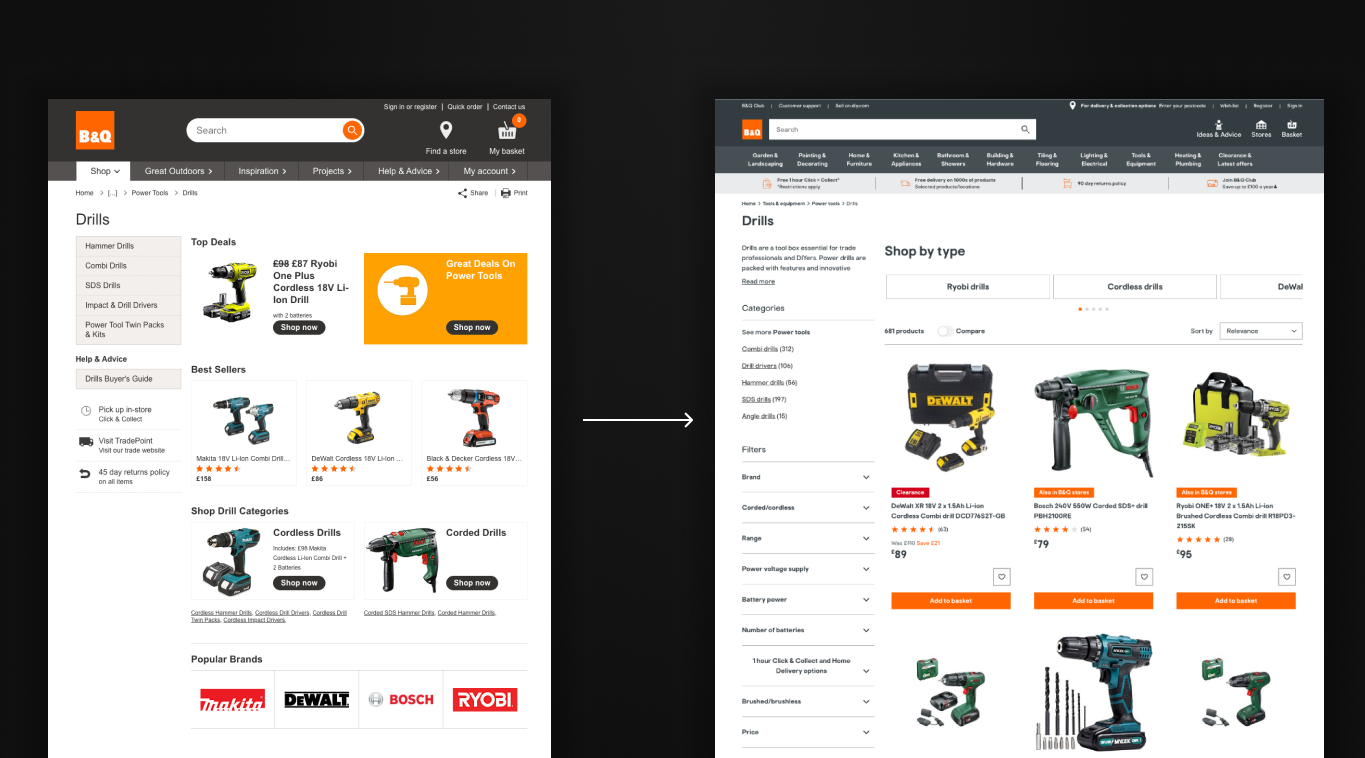
How a product listing page changed over the years

Homepage, product page and checkout iterations
02

Service & Fulfilment

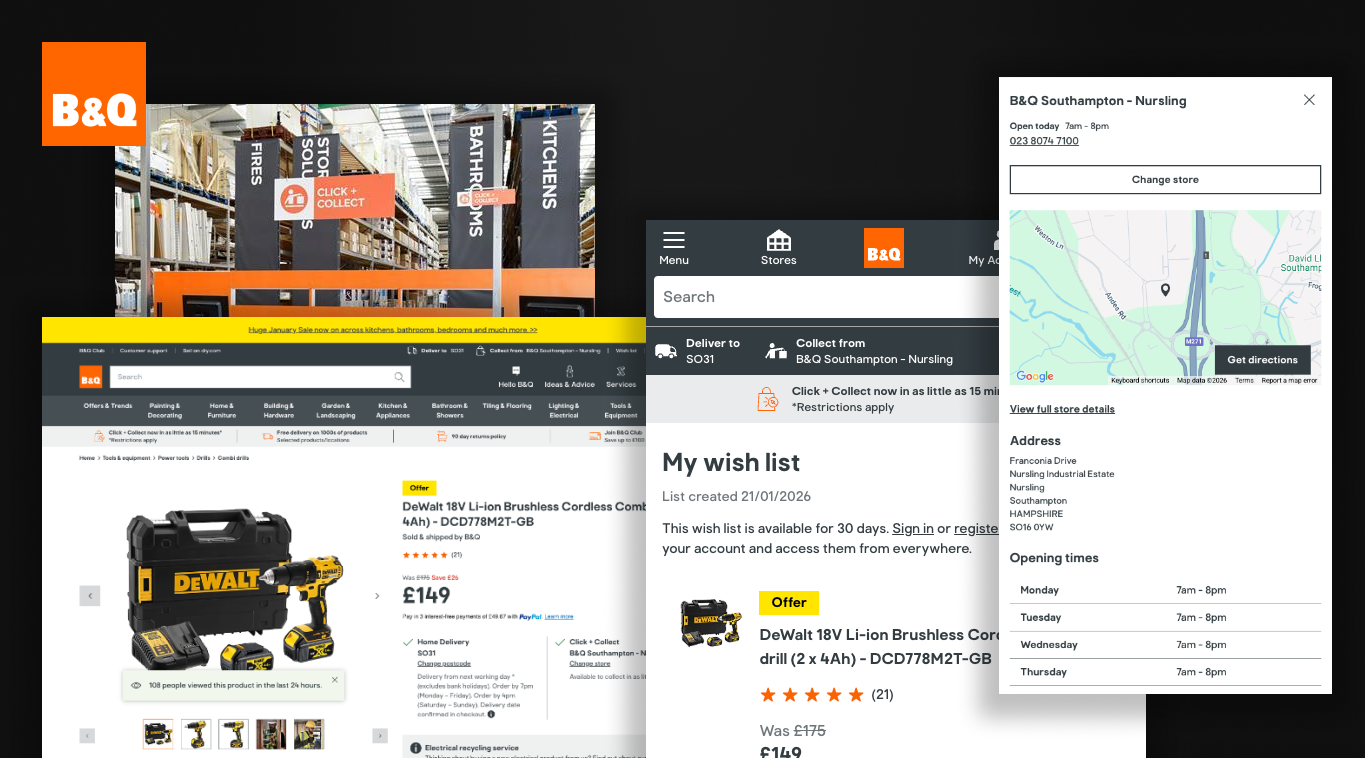
The website increasingly bridged online and in-store: timed Click & Collect slots with readiness notifications, persistent wish lists, clearer delivery windows and online booking for kitchen design, tool hire and timber cutting.

Click and collect desk, product page, wish list and store details

Click & Collect, wish lists, store services

03

Omnichannel Integration

B&Q customers move fluidly between channels. We built for that reality: real-time stock, store aisle locations and baskets that persisted across channels.

Key decision

Real-time stock as a core feature

Stock moved from secondary detail to primary element — on search results, product tiles and always within one tap. Accuracy was non-negotiable.

Outcome: Click & Collect grew to 40% of orders. In-store stock checks from mobile rose 300%.

04

Performance

DIY customers are often in garages, sheds and building sites with poor connectivity. So we treated performance as a feature.

Key finding

Largest Contentful Paint improved from 4.2s to 1.8s — estimated to contribute 12% of the conversion improvement.

Measuring what matters

Growth on this scale takes many teams. Our part was the template that carried it, built up over years of continuous improvement and two platform transformations.

Business impact

70x

Weekly revenue

£200k to £14M, making digital a core channel.

40%

Click & Collect share

Omnichannel drove store traffic and convenience.

+34%

Conversion rate

Across both platform transformations.

User impact

+23%

Search-to-basket

Project-based navigation helped people find what they needed.

1.8s

Page load

Down from 4.2s for customers on poor connections.

+18

NPS improvement

Satisfaction with the digital experience rose.

Reflections

What I learned

Push harder for the platform

I knew a centralised platform would give us more scalability and flexibility, and I’d push harder for it now. Sometimes the business overrode me to get something out before it was ready, with a promise to come back to it. We never did.

Performance is a feature

Speed is user experience, especially for customers in garages, sheds and on building sites with poor connectivity.

Meet customers where they are

DIY customers are online and in-store, sometimes in the same hour. Design for the journey, not the channel.